Friday, September 4, 2015

  
In the 1860 presidential election, Abraham Lincoln faced heated debates and conflicts with other men running for president. As Doris Kearns Goodwin eloquently writes about in the her award-winning book Team of Rivals, after being elected, Lincoln didn’t look past his opponents’ differences, he embraced them. He made three of his fiercest critics cabinet members in his administration - not despite their opposing views - but perhaps precisely because they disagreed. What made Lincoln a remarkable person and one-of-a-kind leader wasn’t just his ability to persuade others, but his ability to listen and learn from others - even those that vehemently disagreed.

The same principle applies to high-functioning teams and effective classrooms. Teamwork is not just about singing Kumbaya around a campfire or falling into each other’s arms during a trust building exercise. Teamwork also is about sharing different perspectives, having the courage to hold each other accountable, and having the opportunity to disagree. Watch any winning sporting team and you will see players clearly telling other players what they think and coaches visibly disagreeing with how a situation was handled.

I have the pleasure of participating in several school leadership meetings and visiting classrooms in a wide variety of school districts. I never worry about the teams or classrooms that have open disagreement - even when emotions run high at times. In fact, I am more concerned by meetings and lessons where people sit quietly and just wait for the boss/teacher to tell them what to do. Many high school students in particular go through a phase where they want to challenge almost everything. So, instead of just fighting that tendency, I suggest we leverage it, channel it, and perhaps most importantly, explicitly teach it.

Dr. Robert Marzano, an iconic researcher of effective educational strategies, calls this a cognitive skill and contends: “When students understand the general framework for a well-supported claim, they can more effectively present and support their own claims.” In fact, in his book, Classroom Instruction that Works: Research-based Strategies for Increasing Student Achievement he reports that this one strategy yields 23 gains in student achievement. Really, the point is simple: Let’s not just teach students and employees what to think. Let’s teach them how to think and challenge them to sharpen their ability to communicate their own thoughts.

Whether it’s in a board room or a classroom, suppose you were given one hour to take a position on one of the below issues:
  1. Should there be mandatory year-round schooling for all students?
  2. Should football be allowed as a high school sport because of the risk of injury to players?
  3. Should teacher pay be based on student test scores?
How would you go about making and supporting your position? Would you try to find facts that support your claim? Would you contact other people? Would you try to find counterpoints to your position? Would you collaborate with others in forming your argument? Would you have to synthesize a lot of information from various sources quickly to present it in a logical, compelling way? Would you use technology to do all of the above? I’m guessing the answer to most, if not all, of these questions is yes.

In the classroom, a teacher might ask open-ended questions, such as the following:
  1. Should nuclear power be used as a source of energy? (MS/HS Science and/or World History)
  2. Would you rather have a job that guaranteed you a salary of $100,000 for the rest of your life or a job that had a starting salary of $65,000 with guaranteed 5% raise each year. (Middle School Math)
  3. Do dogs have feelings like people? (Elementary Language Arts)
  4. What suggestions do you have on how we can make our classroom more productive? (K-12)
For students, this exercise will certainly open the door to discussions about the mechanics and methods of making a good argument. For adults, this topic lends itself to conversations about what makes a high-functioning team.

We also know that not all arguments are healthy or yield better outcomes. So, before your classroom or conference room starts looking like an episode of The Jerry Springer Show, I offer these suggestions on how to bring more healthy debate to your environment:
  1. Establish “Norms”
    There is a difference between disagreeing and just being disagreeable. When someone disagrees, it should feel like they are challenging the position or approach on a specific topic. When someone is being disagreeable, it feels like they are attacking the person or group of people. To help create the former without the latter, openly talk about how people should and should not disagree. Create meeting or debate “norms” that acknowledge that disagreeing is necessary, but also guides the right way to go about it. Sample meeting norms might include
    • Everyone participate.
    • No one dominate.
    • If you don’t agree, it is your responsibility to speak up.
    • Listen carefully to understand.
    • Talk with others, not over others.
    • Laughing is highly encouraged. But, laugh with people, never at.  
  2. Choose Carefully What Topics to Debate
    Although fostering discussion and debate is healthy, debating every issue can be exhausting and can ultimately cause people to withhold opinions for when they really matter. If you ask ten adults in a meeting what color paper to use when printing a meeting agenda, you might get 10 opinions. But, that doesn’t mean you need to debate the topic until you have some consensus with the group. When these type of disagreements surface, just make an executive decision or pick someone that gets to decide - even if it involves flipping a coin. Likewise, in the classroom, there will be some topics that aren’t up for debate. Save people’s energy and passion for the topics that really matter.

  3. Role Play
    Instead of asking people if they agree with an idea, ask questions like: 
    • Everyone write down at least one argument on why the idea is bad and be ready to share with the group. 
    • Everyone write down at least one argument on why the idea is good and be ready to share with the group. 
    • Suppose we want to really mess up this idea, what we would do to make it go terribly?
    • Suppose we were going to do this, how would we go about it? 
    Be clear that this isn’t an exercise on seeing who agrees or disagrees; it’s an exercise to help everyone see the problem from as many perspectives as possible.

  4. Let the Best Idea Win
    I know that we live in a world where we like to declare winners and losers. And, certainly if you are an attorney or arguing in a debate club, you want the ruling to go in your favor. However, the purpose of most real-world arguments isn’t really about you being declared the winner; it’s about finding the best answer to a question or solution to a problem. So, when teaching people how to argue, it’s equally important that we encourage people to not only be good at convincing others, but also be good at being convinced. This requires listening to learn from others, seeking compromise, and not just finding what’s wrong with an idea, but finding what is right about it. Often, the best idea or course of action isn’t at the extreme of either position. The sweet spot is often the middle ground. Also, good ideas that are poorly implemented can actually end up more damaging than bad ideas that are implemented well. Arguments are not always about picking between two paths; sometimes it’s about creating a new path and ensuring you are fully prepared to go down that path.

  5. Move Your Meetings to the Parking Lot
    We’ve all had parking lot conversations. After spending two hours in a meeting, you walk out of the meeting to find yourself standing by a car telling someone what you really think. This may be because you didn’t feel you had the opportunity to voice the concerns in the meeting and becomes a way to vent frustration. But, these conversations don’t just undermine the team’s decision made in the meeting; they undermine the team itself. So, to keep this from happening, you can either move your meetings to the parking lot (not very practical) or create the time and culture within your meetings for those conversations to occur. This is true both in the conference room and for the classroom. 

So, the next time you have a topic of disagreement in your office or in your classroom, borrow from the remarkable wisdom and leadership of Lincoln. Avoid, the temptation to control and kill the conflict immediately and instead embrace it. The fact that you are arguing is a testament to the fact that you have a team with different perspectives (which is a good thing) and, perhaps most importantly, evidence that your team cares.

Tuesday, July 7, 2015


Some have claimed that Henry Ford once said, “If I had asked my customers what they wanted, they would have said a faster horse.” I know there is some dispute on whether or not Ford made this statement; regardless, the statement carries a powerful message. Sometimes asking customers what they want doesn’t uncover what they need - not because they lack a vision but because the question itself doesn't invite a conversation about possibilities.

There is a movement occurring in several schools across the nation - to provide students laptops and/or tablets. Many schools new to this journey often find themselves struggling to decide which device is best for their students. Also, too often the decision process is on a tight timeline. So, the process frequently involves purchasing a variety of devices to test for a few weeks or to pilot in a single class and then making a decision based on what seems to work best and/or seems most familiar and appealing to teachers and students.

Too often, I think this process ends up with… well… more horses.

So, I would suggest schools focus on four questions when navigating this issue:


QUESTION 1: WHAT PROBLEM?

What’s the problem with how many approach this decision? Hint: The first three words of the question also holds the answer: What’s the problem. Instead of beginning by asking what device is best, begin by asking what problem are you trying to solve. Hopefully your investment in the technology has something to do with student skills, so make that your starting point. Although I like some overarching ideas, such as wanting to improve student engagement, student collaboration, or student problem solving, I increasingly find those broad ideas often too abstract to help select a device. On the other side of the spectrum, in attempt to be specific, some state their problem similar to the following: “I want students to be able use Microsoft Word or PowerPoint and have the ability to print." But, this really isn't identifying the problem you want to solve or the student skills you want to improve. Those are tools (among others) that might help solve a problem, but don't mistake tools for the actual desired skills. Here are some examples of skills that you might identify:
  • I want students to know how to make and support a claim - becoming better at finding, interpreting, and synthesizing information. I want them to work with their peers to research a topic, write about that topic, and make presentations on that topic. In doing this, I want them to generate ideas and arguments that can be shared not only within the class but also with an authentic audience. 
  • I want students to be better readers. I want them to have quick access to books that align to their interest and their reading level.
  • I want students to be able to be more self-directed in their learning. I want them to access videos, tutorials, and educational games in order to review concepts that they are struggling to master and have greater flexibility to work ahead.
  • I want students to be self-reflective learners. I want students to have greater clarity of what they have and have not mastered and why. I want teachers to have more efficient and effective ways to regularly check for student understanding.
  • I want my students to be able to connect and collaborate with others in solving problems. I want students to be empowered to take action on real issues that they identify and to recognize the impact they can have in their community and the world.
Ideally, the list of desired skills would be developed by students, teachers, and administrators and would then be prioritized. I would advise that this list not be lead by the technical staff charged with making the devices work. During this stage, you are not trying to solve the problems; you are trying to identify the problems.


QUESTION 2: WHAT CLOUD?

Think of it like buying a house. Long before you start looking at homes for sale, you probably have some idea of your needs (number of desired bedrooms, basement, master bedroom on first floor, etc). But, furthermore, you probably have some idea of where you want to live. Even if a house has the exact floorplan, features, and style of your choice, you probably don’t buy it if it is not in a desired neighborhood, too far from your work, doesn’t have area attractions aligned to your interests, or has a climate that remains too hot or cold for your taste. In other words, buying a house is also a decision about how you will interact with the people and places surrounding the home. After all, the real estate agents' mantra is location, location, location.


Similarly, selecting a computer now is greatly impacted by how well it will interact with the apps and services that you use. And today, these apps and your data won’t just sit on the device or in the main server room in your district. They will live on servers all around the world in what is often simply called the cloud. This applies to apps, pictures, music, documents, and just about anything you save or do on your device.

Let’s look at the three giants in the field: Apple, Google, and Microsoft:
  • Apple has been the master of making its products work elegantly together within their ecosystem. For example, with an iPhone one can turn on an Apple TV or play music from iTunes on an iMac. A picture taken on iPhone can automatically show up on an iPad, Apple TV, and MacBook Air, and iMac without the user doing a thing. None of this is possible without Apple’s cloud.
  • Google is not an immigrant to the cloud; they have always lived there. But over the course of the last 10 years, they have built an entire ecosystem that can now handle most people’s work habits with robust solutions for email, video calls, calendar appointments, task lists, documents, spreadsheets, presentations, and much more - all within their Google Apps environment. Unlike Apple, that largely uses the cloud to backup and replicate data across devices, Google uses the cloud as the primary area to store the data -- making it available to any device that can access the Internet.
  • Microsoft still has a strong hold of the desktop OS, with more than 90% of active browsing desktops still using a version of Windows as of December 2014 according to Net Applications. Microsoft Office 365 and the Microsoft recently designed App Store make it clear that Microsoft also realizes that its future depends on users relying on its cloud.
As time passes, users will care less about what is in their hand and more about the easiest way to access and share their work. In other words, cloud computing has disrupted the way most customers will select products moving forward. We use to buy a device and then think about where to save our work. Now, we think about where our work is saved (in what ecosystem) and then pick a device that will let us most easily access our work. Adopting a cloud is not an easy choice, but changing your cloud platform is even more difficult. The three giants have known this for some time. It’s also why they all eagerly provide access to most (if not all) of their cloud services for free to K-12 education.


QUESTION 3: WHAT SPECS?

Battery life, durability, reliability, speed, ease of use, available apps and features, compatibility with existing apps and websites, cost, and difficulty of support are among the factors that quickly come into play when selecting a device. Although each of these variables, or specifications, are important and every school has unique circumstances, they are much more clearly defined and therefore can be easily measured. What is more nuanced is how well these devices solve a problem. In other words, you really aren’t just testing if the device works; you are really testing your workflow.


QUESTION 4: WHAT SOLUTION?

Back in early 2001, many people were starting to ask the question, what is the best MP3 player on the market? But Apple surprised everyone and rattled the entire music industry by releasing iTunes, the iTunes Music Store, and an iPod that worked seamlessly with those products. And, nearly overnight, it became clear: Apple wasn’t just building a decent MP3 player, they were providing us with a solution to purchase, store, and transport our favorite music.

Similarly, what you are really trying to figure out is how a device, its apps, its cloud services, and other tools solve the key problems that you identified. Answering these questions often does not just flow sequentially, but rather the questions work in tandem with each other. You may find a device that feels right -- that has a killer app - which then drives your thinking of where the data should be stored and ultimately how you go about solving one of your problems. In other words, you should retouch and rethink a step as you move to the next step. Even though people may be asking for a device, what they usually really want is a solution.

So, when selecting a device for your students, the method of getting a few devices in to test for a couple weeks is as outdated as the term MP3 player. Instead, spend the time clearly identifying your problems and explore solutions to those problems. Do this by visiting other schools, talk with colleagues, and/or seek the advice of experts. Although Apple may have made it easy to carry your music in your pocket, the challenges in K-12 education are certainly more complex and the stakes are much higher. And trying to make a horse carry you too far too quickly isn't just foolish; it could be deadly.

Friday, December 26, 2014

This Christmas marks my five-year anniversary of using Google Apps as the primary platform for my work communication and collaboration. We were a little apprehensive as a technology department migrating an entire district to GAFE because at this time Google Apps didn’t have its wide-spread popularity among schools and now increasingly businesses. Although I had used Gmail for personal uses for years, the shift to using it for my work brought a new set of needs, and therefore, uses. Quickly I became one of the biggest Google Apps evangelists. I remember the migration just like yesterday…

’Twas the night after a Google Apps migration, when I sat in a small office in my house.
I awakened my computer by jiggling my mouse. 
I went to Google and entered my email address with great care. 
In knowing that messages migrated from my old email system would soon be there.

My children already were nestled all snug in their beds,
While visions of scattered, unorganized emails messages danced in my head, 
And, I clicked the app launcher, the 9 little squares in top-right of my screen.
Selected the Mail icon afraid to see what the migration would bring.

When there in my inbox sat all my old messages that had always been so scattered. 
I clicked on the first few messages admitting most were too old to still matter.
I went to my settings, I clicked to show the “All Mail,” “Spam,” and “Trash.”
Clicked on a message, then selected the box in my toolbar with the arrow and dash.

I began archiving all the old messages including -- old requests and items for sale,
Knowing the messages would still be nestled in “All Mail.”
When what to my wandering eyes did appear, 
But a number reporting that I still had nearly 30 GB of space clear!

With the power of Google’s search, finding old mail became more quick.
I knew in a moment that this change to Google Apps would be slick. 
More rapid than eagles, my search results came, 
Finding matches before I could even finish typing a name.

Search names! Search subjects! Search words and phrases!
On sent mail! On received mail! On attachments and date ranges!
To find email from people! To find someone’s number that I wanted to call! 
Now I could search about anything! Now, I could search it all!

And then I noticed labels, which are like folders, but much slicker. 
Messages can be tagged with multiple labels making finding them much quicker. 
I clicked the dropdown next to a label adding some color - like red, blue, or green. 
I saw that I could move items to the labels or keep them in my inbox so they’re easily seen.

And then I explored filters which can label incoming mail in an instant.
They helped keep me organized. It’s like having a personal assistant!
Mail also became neatly grouped together by subject - organizing all messages that it contains.
This unique “conversation view” makes managing the flood of email a little more sane.

Clicking the settings let me change my display view from comfortable, cozy, or compact. 
And clicking the drop-down on Mail, let me access my contacts.
The drop-down next to mail also allowed me to manage a Task List,
A handy little tool to ensure all the to-dos in my head are not missed.

A bundle of options all available. There was little it lacked. 
I knew that after using Google Mail, that I’d never go back. 
Starring messages -- makes them twinkle! Cute emoticons are so merry!
Spam gets automatically filtered, and suddenly doesn’t seem so scary!

The more that I learned, the more I wanted to know,
And all these features are available no matter where I go!
When setting up email on an iPhone, I selected the option to use Exchange.
(This actually provides more options. I know that may seem strange.)

On the Android, setting up email was definitely a snap. 
And on the iPhone, I also added the other Google Apps. 
Google Mail was the gift that kept giving, liking having my very own elf. 
It helps me feel more organized, in spite of myself.

In wink of an eye, messages are now more quickly read;
Going through email became something that I didn’t have to dread. 
It’s also not just Mail that I began using in my work.
It was Calendar, Drive, Groups, Hangout, Sites, and other perks.

I now can collaborate and communicate in even an easier flow,
And no longer do I have to remember to save before I close. 
So Google Apps is a great tool - both intuitive and fun. 
And with this great tool, I feel that I can now get more things done.

So, now I want to exclaim to all within sight. 
Switch to Google Apps! It will just feel right!

Tuesday, June 17, 2014


I recently asked my youngest daughter, Lizzie (age 6), what she wanted to be when she grows up. Lizzie promptly replied, “A pet shop owner.” She also added, “and no parrots would be allowed.” I misunderstood her pronunciation of the word “parrot” for “parent.” I asked with a hint of rejection, “Why aren’t parents allowed?” She, still thinking I was repeating the word parrots, said, “Because they are so talkative and just plain weird.” Feeling more insulted and rather bothered with those harsh words, the conversation continued to spiral downward. I started to plead my case of why parents should be allowed; she remained unflappable insisting parrots would not be admitted. I voiced how much her mother and I would like to come to her store. She sat quietly for a moment with a puzzled expression on her face that then shifted to a smile and said, “You and mom can come! I said PARROTS aren’t allowed.”

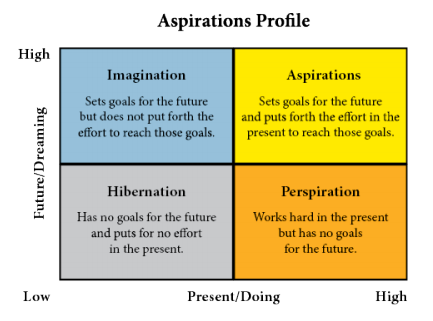
Leaving the parrot confusion aside, the conversation did reveal that Lizzie was rather confident in her ambition of being a pet shop owner. This career choice is a puzzling one to me. We don’t have any pets and she generally hides behind my leg at the sight of any dogs passing by and doesn’t embrace other people’s cats. And yet, she really didn’t see the obvious disconnect between her apparent fear of animals and her desire to be a pet shop owner. Keep in mind, she is 6-years old. Two days ago, she probably would have said she wanted to be a queen of a small island. Nonetheless, our conversation reminded me of a presentation from Dr. Russell Quaglia at the ASCD conference that I attended this past March. Dr. Quaglia shared a powerful message about the importance of making student voice and student aspirations a bigger part of learning and teaching today. He shared a graphic similar to the one below that illustrated aspirations are the intersection of dreaming and doing. As educators, our goal should be to help more students find their way into the upper-right quadrant: helping them define and reach their aspirations.


http://www.qisa.org/dmsView/Aspirations_Profile

I’m a big believer in the power of imagination. History has shown us the importance of dreaming big. John F. Kennedy’s lofty vision of putting a man on the moon just didn’t inspire astronauts at that time; it rallied a nation to appreciate new advances in technology and spawned a whole generation to become more interested in science and mathematics. Martin Luther King, Jr. forever shaped the landscape of racial integration by standing up and sharing his dream with the nation. Having a dream, a vision, a big idea, doesn’t just give purpose to one’s own life; it brings meaning and hope to others. But, dreaming without action - without “doing” doesn’t yield results and is ultimately just thoughts in someone’s head. Had we never landed on the moon or made great strides with racial equality, I’m not sure that President Kennedy’s or Dr. King’s speeches would be remembered more than five decades later. And, although Lizzie might imagine herself as a queen of a small island, that doesn’t make it come true.

The disconnect between Lizzie’s actions around pets and her dreams of being a pet shop owner is not just representative of other six-year olds; this gap of dreaming and doing also exists in many students of all ages – including those just now graduating. We have students who dream of being mechanical engineers or astronauts, who don’t want to take four years of mathematics in high school; students who talk about becoming fashion stylists who don’t enjoy art; and kids who dream of being NBA players who don’t show up regularly for basketball practice.

But, this article is not your typical “kids these days” lecture. In fact, overall, I remain optimistic about our youth and our future. They are a generation who largely want to have their voice heard and want to show value and purpose in their work. They want to do something that matters. So, how do you convince a 6-year old or a 16-year old that their actions of today are what makes their ambitions of tomorrow possible? After listening to speakers like Dr. Quaglia, spending time in classrooms, talking with teachers and students, and trying to navigate the daily rat race with my own children, I’ve become increasingly convinced that it’s not what we tell the students that shapes their thinking and actions the most; it’s our ability to ask the right questions and to inspire them to become better questioners themselves.

After I asked Lizzie what she wanted to be, I altered the question to, “Who do you want to be?” “In other words,” I explained, “what do you want others to think about you when you are older?” She paused for a bit and then shared the following adjectives as her desired qualities on what she would want others to use to describe her: nice, kind, loving, active, caring, hardworking, curious, and smart. These powerful words guided our conversation into how she can make others feel this way about her. Almost magically, she began rattling off countless actions she could take now. It wasn’t an abstract conversation about some far-off future. It was her “to-do list” for tomorrow at school.

In the book To Sell is Human, Daniel Pink shared a tip in asking the right question in sales that also works with children. He suggests if a teenager doesn’t want to do their homework, ask the teenager: “On a scale of 1 to 10, with 1 meaning ‘not the least bit ready’ and 10 meaning ‘totally ready,’ how ready are you to study?” So, I tried this with my older daughter, Anna Mae (age 9), as he suggested. After rating her desire to do homework as a 3, I asked Pink’s essential follow-up question: “Why didn’t you pick a lower number?” I simply was amazed to hear her giving me reasons on why she should do the homework, exactly as Pink had described. In other words, instead of me barking out my normal do-your-homework-or-else threat, by asking the right question, Anna Mae made the argument herself about why the homework was necessary and conceded rather quickly to do the work.

By sharing these examples, I’m not claiming that I have the art of asking questions mastered. Too often I fail to ask the right questions in my job and in my home. I also know how difficult it is to step away from the front of the room and let go of being the great explainer and instead embrace becoming a better questioner. But, we know that giving our students both a voice and choice in their learning and asking thought-provoking questions - instead of reciting facts - is more effective in helping students become better problem solvers and ultimately better learners. And by doing so, we help empower students to find that powerful combination of both dreaming and doing, reaching their ambitions.

So, each day, I work on being better at asking questions. My hope is that someday both Anna Mae and Lizzie achieve their ambitions. And if Lizzie does become a proud owner of a pet shop, I hope she will fight the urge from banning me because I’m too talkative or weird.


(This article was also posted here on Five-Star Technology Solutions blog.)

Tuesday, April 22, 2014


I don’t mean to boast, but I’m the dapper, long-eared smiling rabbit in the photo. This Easter weekend, for a few hours on a warm and sunny Saturday afternoon, I became the Easter Bunny for the Danville Kiwanis Easter egg hunt. I gave out hugs, high fives, and photo ops with babies, little kids, big kids, and even adults. I stood in the center of a grassy field surrounded by thousands of eggs and watched kids ages 9 and under scurry to the colorful spots wrapping their tiny fingers around the eggs and plopping them into their decorative baskets. Perched on a bridge, I also had the pleasure of pulling the “release hatch” on a giant basket filled with hundreds of rubber duckies to start the duck race contest down White Lick Creek.

After my debut as the furry friend, I began reflecting on my experiences of the afternoon. Oddly, the lessons learned seemed eerily familiar to some of my experiences as a technology leader. And so, whether you are taking on the role of Easter Bunny or trying to become a better leader, I offer the following suggestions:

1.  Be prepared to sweat to accomplish anything that has significant meaning.
Overall, playing the role of the Easter Bunny brought a lot of joy and fun. But, it wasn’t all fun. There were a few unwelcoming parts of the job, like the fact that the suit was hot and rather uncomfortable. Everyone warned me it would be hot, but it felt like I stuffed my head into a giant bowling ball with just enough ventilation to keep me alive for an unspecified limited period of time. And yet, I couldn’t wipe the smile off my face. (OK, the bunny smile was hard-molded plastic, so that might not say much. But even as I gasped for air inside the suit, I couldn’t stop smiling.)

Leaders, recognize that meaningful change is hard work for everyone. Avoid being trapped by the false choice argument that something is either right or difficult. Often what is right is also difficult, not just for you, but for your team. Don’t hide the difficulty; celebrate it. Your team’s passion to do what is necessary, not just what is easy, is a mark of just how much your team cares. 

2.  Support even those that want to run away. 
When imagining myself dressed in a bunny suit, I could only picture the enthusiasm of kids excited to see the Easter Bunny. I forgot that some kids, little kids especially, might not have complete confidence in having a white hairy creature with beady eyes and a creepy smile hold them. So, when the first kid in line started to scream when their parents nudged them closer to me, my own enthusiasm and excitement began to fade. But, after reminding myself that “my look” was anything but normal, I quickly replaced my feeling of rejection to empathy for the toddler’s fear of the unknown. I also could relate to the mother that was clearly reluctant to hand her child to a stranger in a bunny suit. My role was to encourage, but not force. I would reach out a paw, so small kids could at least touch my fur. I took pride in knowing that even the ones that walked away screaming may feel just a little more confident to face the big white bunny again next year.

Leaders, be prepared for the fear of the unknown. Listen not just to the people cheering, but also pay attention to the people fussing. Your role is to provide clarity and comfort not just to those that understand and support your vision and initiatives, but also to those that don’t. The best way to win others over is with a steady hand and trusting nature. Certainly, you will face the occasional obstinate person that rejects any new idea. There is also a parent at every Easter Egg hunt that loses the spirit of the activity and becomes a little too competitive in their pursuit of the eggs. These small exceptions may require a firm and direct intervention that isolates or removes a person from the situation. But, don’t confuse a few difficult people with those that are having difficulty implementing an idea because they are confused, afraid, or frustrated.

3. Show others that you are human. 
As uncomfortable as I felt in the suit, I found it very amusing to see how adults react to a man in a white bunny suit waving at them. I would wave with jubilant enthusiasm to people of all ages. Some adults play along and wave back. But others, would look at me, look behind them to see if there was some child grabbing my attention, and then sort of hang their head as if they hadn’t noticed me. Sure, waving at a goofy bunny that isn’t “real” feels a little ridiculous. But, smiling and waving doesn’t make you look stupid or weak; it makes you look real.

Leaders, show others that you are human. Admit your mistakes and be tolerant of others’ occasional missteps. Understand people’s interest and passions. Let them know about your interests and social lives and take time to learn about their interests and social lives. Laugh. A lot. It shows others that you enjoy your work, the company of your team, and that you are real.

4. Maintain a clear vision of where you are going at all times.
The holes in the bunny eyes provided a view of the world straight in front of me, but all peripheral vision – left, right, and up and down - was lost. So, as a mother extended her arms with her small infant for me to hold, it felt like someone turned out the lights right as the handoff occurred. When walking around outside, it was hard to see my feet. But, by keeping a focus on what was several yards in front of me, I was able to better predict and respond to what surrounded me.

Leaders, every day your time can be swallowed by all the issues that are hot topics at that moment. But, the only way to avoid reactively moving from crisis to crisis is to keep your eye on where you want to take your organization. Furthermore, you must not only have a vision for what you want your organization to accomplish, your team must also share that vision and must know if they are heading in the right direction.

5. Seek the help and guidance from others. 
Luckily, I had two “bunny handlers” that made sure that I didn’t drop a baby or step on a toddler. They also made sure that I knew where to be throughout the event and helped me stay on schedule by politely escorting me when it was time to go to my next stop.

Leaders, seek the input, advice, and guidance from your team and take a tip from Teddy Roosevelt who said, “The best leader is the one who has sense enough to pick good men to do what he wants done, and the self-restraint to keep from meddling with them while they do it.”

6. Say “thank you.” 
My heart nearly melted when a little preschooler gave me a hug and said, “Thanks, Easter Bunny, for coming to my house.” That moment of gratitude made the experience completely worthwhile.

Leaders, we often underestimate the power of a simple, but genuine, “thank you.” Often people feel undervalued not because of lack of pay, but because of lack of praise.


In all six of these areas, there is always room for improvement - certainly as a bunny and as a leader. I’m not claiming that I always practice each of the suggestions above as a leader. Each is certainly easier said than done. As the Easter Bunny, I made mistakes, such as unwittingly knocking over a toddler. And some of my best responses or actions as a leader unfortunately have occurred only mentally late at night when I reflect upon a situation that I think could have handled better. The nice thing about leading is that the chance to improve doesn’t just come the first Sunday after the full moon following the March equinox. The chance to become a better leader comes with the sunrise of each day.

You are most likely a leader of some kind of team: a sport, a class, a building, a district, an organization, or business. Please share your thoughts or leadership strategies. I would love to hear what works for you? What doesn't?

Monday, February 24, 2014

While watching freestyle skiing in the winter Olympics, I began wondering how the amazing athletes got their start. I imagine my daughters, Anna Mae (8) and Lizzie (6), standing in skies at the top of a steep mountain looking down at a ramp in front of them shivering with intimidation of making the jump for the first time. The silence of the mountain top is interrupted with my tough-love voice saying, “OK, girls, here’s what you gotta do. Just lean forward and let the hill and ramp do its thing. When you are naturally propelled in the air, do about three back flips, followed by four or five twists and just be sure you land on your feat... You got this.” And with that and a strong slap on the back, Anna Mae and Lizzie accelerate down the hill to the ramp, fly high into the air, complete the stunts and stick the landing - proving instantly they too are Olympic-contender material.

The formula seems simple really: A little guts + A strong slap on the back = Gold medal.

In a reality, I know that the incredible skills and courage of the skiers and all Olympians are built instead by hours and hours of practice, lots of failures, and incremental success. They aren’t reckless maniacs or freaks of nature with unnatural ability and nerves of steel. They are dedicated and driven competitors that push themselves to be the best. They weren’t born destined to be Olympic skiers. They have become the world’s best not because they haven’t fallen. They are the best because they recognize falling and failing is a part of learning.

The secret formula is really no secret at all: Practice, lots of failure, and incremental success. (Rinse and repeat.)

In Mindset, Carol Dweck makes the powerful case of embracing and teaching a growth mindset, the notion that abilities are continuously developed through dedication and hard work, rather than adopting and reinforcing a fixed mindset, the notion that intelligence or talent are fixed traits. This TEDxTalk shares some surprising results of how a growth mindset impacts student achievement. In Outliers, Malcolm Gladwell dispels the idea that the best athletes, musicians, and industry leaders are destined to be great because of unmatched intelligence or even ambition. He cites case studies such as The Beatles and Bill Gates to make the point that success comes often from life’s circumstances, matched with lots of practice (10,000 hours according to his studies). Recognizing the importance of learning from failure, Penn State now even offers a freshman seminar course at Penn State called “Failure 101.”

I’m a math enthusiast and technology enthusiast. When helping others in both of these areas, I’m always struck by how people often quickly label themselves as good or bad with technology or good or bad in math. In reality, the label is never quite accurate. Becoming good at math and technology - and probably just about anything in life - isn’t just some event that occurs on a mysterious day or an attribute that is selectively bestowed on some people. The person confident in math likely excels because he or she has found a way to chip away at the difficult problem even when stuck. A person becomes skilled with technology because he or she chases curiosities and finds a path that works by first exploring what doesn’t work. A roadblock doesn’t become a dead end; it simply becomes a moment of redirection - of seeking and finding a new path to take. I feel fortunate that my daughters’ teachers continue to see failure as temporary. One of the teachers encapsulated this idea perhaps best by telling students to put a smiley face next to every problem they missed because it’s an opportunity to learn something new.

At home, I also try to be very deliberate about recognizing and rewarding effort and embracing mistakes with my girls - reframing shortfalls as opportunities. And yet, at the very same time, I often find myself frequently voicing the fixed mindset or avoiding failure in my own actions. I denounce hair bands and all forms of hair braiding - claiming that I just don’t have what it takes to braid my girls’ hair (or tie a decent hair band for that matter). I declare myself a “bad cook” - without admitting that I’ve only tried making brownies once in my life (which was yesterday). For my job, I recently took the necessary exams in order to become a Certified Educational Technology Leader. There was really only one thing that made me very reluctant to take the test. It wasn’t the cost, the suggested reading materials, the testing center, the material itself, or the fact that I already had a technology leadership job. My apprehension was built simply on the fact I was scared that I would fail.

Let’s face it. Practice is often tedious and frustrating. And, failure is often disheartening and embarrassing. As educators and parents, I think we must not only share that failure is OK, we must embrace it and embed it within our policies, programs, and practices. We must reinforce that aiming and missing is for better than not aiming at all. The point isn’t about false praises or artificial rewards. I don’t want every kid on the soccer field to get a trophy for trying. Instead, I want every kid to know that getting better is the reward for trying and that losing is most often the best teacher of how to win. Finally, we must accept that our actions generally speak louder than our words. We don’t just teach students during our great lessons and model good leadership in teacher inservices that go exactly as planned. When lessons and inservices don’t go well, we have the opportunity to acknowledge, embrace, and teach that we are all constantly learning, growing…. and, yes, failing.

So, what impresses me most about an Olympic freestyle skier, is not their mid-air flight off the peak of a ramp; it’s knowing they repeatedly pull their face out of the snow from the bottom of the hill to get ready for the next run.

Sunday, January 19, 2014


This past summer George Saunders delivered the convocation speech at Syracuse University for the class of 2013. What advice does a bestselling American writer give to some of our nation’s best young minds about to enter the workforce? Try to be kinder. Below is an an excerpt from his speech that was published here in the New York Times 6th Floor blog.

What I regret most in my life are failures of kindness.
Those moments when another human being was there, in front of me, suffering, and I responded…sensibly.  Reservedly.  Mildly.
Or, to look at it from the other end of the telescope:  Who, in your life, do you remember most fondly, with the most undeniable feelings of warmth?
Those who were kindest to you, I bet.
It’s a little facile, maybe, and certainly hard to implement, but I’d say, as a goal in life, you could do worse than: Try to be kinder.
As a parent, kindness is something I find myself endlessly trying to teach my kids. “Say ‘please’ and ‘thank you.’ Be tolerant and embrace the differences in others. Include others in your game. Shake an opponent’s hand after the soccer game. Lower your voice.” Even as I correct their behavior, there are the moments - like when my toe hits the corner of our sofa or when Andrew Luck throws an interception - that words of kindness aren’t rolling off my tongue. I keep hoping for that day when I can put a checkmark next to the home learning objective: Be kind. But, no matter how many lessons that I give, I realize there is another lesson waiting.

We might agree that kindness is important quality to teach our children, but do we put a premium on this trait like other attributes? I recently tested this by asking several people this question: “Would you rather be smarter or kinder?” Nearly everyone I asked said smarter. It’s possible that my small sampling of people are heartless overachievers that have already reached the maximum limit of human kindness. Perhaps the sampling is not reflective of how most would answer, but I’m guessing most would pick smarter. Being kinder just seems too subjective - just a little squishy. We live in a world with winners and losers, where we strive to find our “competitive advantage.” We recognize and reward hard work and sharp minds. Doesn’t the nice guy always finish last? Is Saunder’s message of “try to be kinder” really a message that will appropriately guide recent college graduates?

This past week the world lost a kind and loving man, John Finlay, who died of complications from pneumonia. John worked as a technician in our Danville Schools’ technology department from 1998 - 2012. During that time, a lot changed in the world of technology. But, throughout all our changes, something remained constant: John’s genuine, kind-hearted nature. As a result, there was an amazing outpouring of support, love, and fond memories shared this week while those of us that loved him coped with his loss. I was able to hear stories of his deeds that range from him putting on puppet shows at his church to the simple way he greeted and welcomed strangers.

These stories and his loss not only remind me of what a good man that John was but certainly causes me to reflect on my own life and the power of kindness. I am in education because I truly want to make a meaningful difference to this world. When my time comes, I hope that I have done something that will have made the world a little better. This perspective often causes me to work long hours on a project that I want to get “just right” or lie awake at night because I know the day is ending with too many teacher help tickets still open. I often justify the time that I spend working on weekends and evenings to myself because I believe the work matters. I know the project I’m working on will benefit teachers, which will help our students gain new knowledge and/or skills that will ultimately give them a brighter future. But, through this persistence and dedication to bring a brighter future to our students, I feel that I too often lose sight of bringing a brighter day to the people in my lives. And, when my time comes, I doubt few will stand up and talk about the number of iPads deployed or the number of closed help tickets. As George Saunders contends, the memories (good or bad) will be the way I have made people feel.

Kindness certainly consists of many small moments - saying “good morning” or “thank you,” listening sympathetically to a frustration, or making someone laugh when they most need it. But, being kind is also about doing what is right, even when it’s what’s not easy or popular. It’s about having the courage to disagree with others’ ideas when necessary, the compassion to defend and assist a person being ridiculed or someone in need, and the confidence to believe that you can help. For a quality that is a little “squishy” to talk about, it’s rock hard to keep practicing.

At John’s funeral, I was struck not by the sadness in the room (although there was certainly grief among so many that loved him) but by the joy that so many shared through his acts of kindness. Even though his life ended too soon (at the age of 58) with little warning (he had been sick only for a couple weeks), I felt that he probably died with little regrets.

Try to be kinder.

As I reflect on John’s life and then my own, I recognize that Saunder’s message wasn’t just good advice for college graduates, it’s good advice to me and all of us. We can all choose to be kinder.
Subscribe to RSS Feed Follow me on Twitter!